Friday, August 18, 2017

On the Trail of William Wood, One of Sandwich's Ten Men

There are times when I'm in the midst of writing about history that I wonder why I chose this task. Why didn't I choose to write about someone who's actually living and breathing? Someone like Taylor Swift, Michelle Obama, Jennifer Lawrence, Robert Downey, Jr., or even Brad Pitt? 
      

          I envy authors who write current biographies. They can search the internet for news articles. They can read People magazine with its juicy gossip and glossy, color-saturated photos. And, of course, they can arrange to interview their glamorous subjects in fancy restaurants where they can sit in comfortable chairs and talk and laugh and share numerous bottles of expensive red wines. But after gathering dry facts from dry history books and poring through dusty archive files containing the occasional grainy photo, a historical biographer like me can only get to know her subject by using her imagination. 

          After reading more than a few history books, I still knew relatively little about my subject, William Wood, other than that he was one of the Ten Men of Saugus who founded the town of Sandwich in 1637. There were no cameras back then, and no one painted a portrait of him. He was about twenty when he came to America, and he must have dressed like a Pilgrim or a Puritan. Maybe he looked something like this:

          Not exactly sexy. Definitely not Brad Pitt. But William Wood was an author, and for me, that's cool. He wrote New England's Prospect, and he was also Sandwich's first town clerk. 

          Town clerks write. They record marriages, births, and deaths. It makes sense that the early settlers would have chosen Wood to be town clerk because he liked to write - and he was good at it; he had written and published a book. I knew it would be hopeless to find any artifacts that Wood left behind; something like that wouldn't help me much anyway. But I wondered if I might be able to find a document he wrote. 

          Historic imagination has to be fueled by facts gleaned from documents and artifacts. Documents contain written words. Artifacts are things made by human beings, things like arrowheads and blunderbusses, wooden butter churns and pocket watches, 45mm record players and Model T Fords. Artifacts like these reveal a lot about how things were done at the time the artifact was made. Very old documents are also considered artifacts because historians can learn a lot from them about how things were done during the time when they were written.

          To feed my historical imagination, I visited Plimoth Plantation and talked to the young man who portrays Governor William Bradford in the English village to get an idea of what writing was like in the 1600s. Back then, girls were rarely educated, and those few Pilgrim and Puritan boys who learned how to write used goose-quill pens they made themselves and ink brought to them on ships as they arrived with more settlers from England. Lacking dictionaries, writers were creative spellers, and they formed their letters differently. For example, an f-shaped s was used when the letter s was doubled or used initially. Common abbreviations included wt for with, yt for that, and ye for the.


Plimoth Plantation's Governor William Bradford pens his journal, Of Plimoth Plantation. Notice the ink pot and quill pen.

First page of Governor Bradford's journal. How many misspellings can you find?

Sandwich's Town Hall Annex houses the Town Clerk's office.


          Next I went to Sandwich's town clerk's office on Main Street where some of the oldest documents in Sandwich history are locked in a walk-in safe.

          Sandwich's town clerk is Taylor White. Interestingly, Mr. White has an active interest in preserving town records and making them available to the public through his office. He is creating an electronic searchable database for 75% - 85% of Sandwich's vital records (marriages, births, and deaths) dating back to the early 1650s. He has already finished up to 1885, crosslinking the digital data to images from a book of records published by the New England Historic Genealogical Society, an organization that helps family historians. Eventually genealogists will be able to visit Mr. White's office to search for information about their ancestors.
Sandwich's vital records are published in several volumes like this one.

          In the photo below, Mr. White is holding a book of restored documents dating back to 1650. This book contains documents from the early 1650s, when William Wood was living in Sandwich.

Town Clerk Taylor White
          After Mr. White handed me the book of documents, I set it on a side table and began flipping through the pages, looking carefully at the dates. I knew that William Wood sold his Sandwich property sometime in the spring of 1650, so if I wanted to find something he wrote as town clerk, it would have to be dated before then. It didn't take me long to find what I was looking for.

Jan. 4th, An. [in the year]1650  It is agreed upon by the towne to pay unto Richard Bourne 20 shillings... in consideration of his labour and paines that he has taken in businesse concerning the towne... 

          This document most likely was penned by William Wood. Hurrah! 

          Besides imagination, historians are infected by another disease of the mind and heart, and that disease's name is Curiosity. Now that I had found a document written by William Wood, I wondered what his signature might look like. “I think, at a child's birth, if a mother could ask a fairy godmother to endow it with the most useful gift, that gift would be curiosity,” said Eleanor Roosevelt. But most of us also remember that curiosity killed the cat. It can also bring great surprises and deep disappointment. Even though he's not Brad Pitt, I hope you'll continue to read the next installments of my blog to discover what surprises and disappointments were in store for me as I contined to delve into William Wood's life story. 

Helpful Link for the Curious:

For more on early 17th century penmanship: http://www.rootsweb.ancestry.com/~mosmd/pilpen.jpg 

Saturday, August 12, 2017

Why the Wrong Spelling Can Sometimes Be Right, or How Mapmakers Collaborate


In the beginning God created the heaven and the earth. And then, in 1507, Martin Waldseemüller did his best to map it.
"A Map of the World According to the Tradition of Ptolemy and the Voyages of Amerigo Vespucci," 1507
Waldseemüller's map is huge, 54 x 96 inches, and it's famous, not because he was the first to try to draw the world, but because he wrote the word America on the continent we call South America. Waldseemüller obviously had no idea how big North and South America actually are, but he got a lot right compared to past mapmakers.


How did Waldseemüller figure out how to draw his map? He wasn't a surveyor, he didn't have satellites or a GPS, and he had never travelled very far from his homeland, Germany. But he studied maps drawn by others and listened to explorer's stories.  In particular, he paid attention to a story told by explorer Amerigo Vespucci, who proposed in a letter that the lands Columbus discovered were a “New World, because none of those countries were known to our ancestors . . . I have found a continent in that southern part more populous and more full of animals than our Europe or Asia or Africa.”

Fast forward a hundred years, and along came John Smith, an Englishman who earned his fame in Jamestown, Virginia, explored the New England coast, and mapped New England from Maine south to Cape Cod, among other accomplishments. To draw his map, Smith probably used a compass, astrolabe, sextant, and a lead line to measure ocean depth.

astrolabe
compass

sextent
John Smith's 1616 map, New England Observed
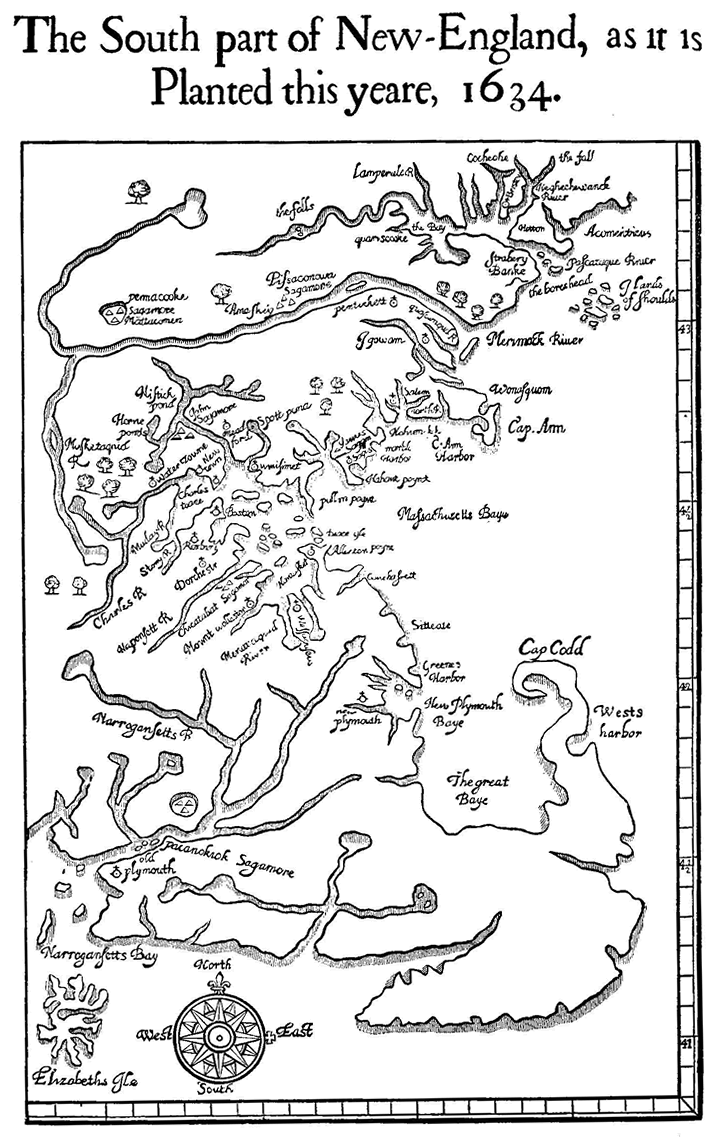
Before William Wood's 1629 voyage to Salem, historians believe he probably saw and studied John Smith's map, and then in 1634, he drew his own.


As far as we know, Wood never drew any other maps, and he probably wasn't a surveyor or mapmaker. So how did he draw such a relatively accurate map? I didn't have a clue until one day when I happened to randomly enter the title of Wood's book, New England's Prospect, into a google search bar. Fortunately, I mispelled the title, omitting the apostrophe and s, and this is what I found: New England Prospect: Maps, Place Names, and the Historical Landscape, a periodical, it turned out, that's available only in a few places, including Brown University. A few days after I made that accidental spelling mistake, I drove to Providence, Rhode Island to do some investigating.

John Carter Brown Library, Brown University, Providence, RI


Interior, John Carter Brown Library

I called ahead, so it didn't take long for the librarian to deliver this booklet to me.


And inside, this is what I found:


Map of Boston area drawn by unknown surveyor for Governor John Winthrop, 1633,
with notations written by the governor.

"A map of considerable importance in understanding the early toponymy [place names] of eastern Massachusetts is Governor John Winthrop's manuscript plan of the Bay Colony plantations, apparently drafted in 1633 and thus probably the basis for the noted William Wood map in New England's Prospect of 1634. The Winthrop plan depicts the overlap between native and English settlement with great accuracy. Clearly shown are the Indian wigwams on the Mystic and Neponset Rivers with the Puritan plantations set along the Charles River from Boston to Watertown," wrote Professor Arthur J. Krim.

I like to imagine the people William Wood met in his travels. Was Prof. Krim suggesting that William Wood met with Governor Winthrop and looked at his map before drawing his own? It seemed to me to be so.

Governor John Winthrop, 1587 - 1649


For more about Martin Waldseemüller's map: 
http://cartographic-images.net/Cartographic_Images/310_1507_Walds.html 

For more about John Smith: 
http://www.smithsonianmag.com/history/john-smith-coined-the-term-new-england-on-this-1616-map-180953383/#OXIxbhPMuP27qcRo.99

John Smith's map: 
https://www.penobscotmarinemuseum.org/pbho-1/collection/john-smiths-map-new-england-1616

For more about Governor Winthrop's map: Narrative and Critical History of America by Justin Winsor, Vol. 3, published by Houghton Mifflin in 1884, note on page 381. (Professor Krim referred to Winsor.)
https://archive.org/stream/narrativecritica03wins#page/n0/mode/1up


Tuesday, August 8, 2017

The Cratchets at Plimoth Plantation

Bob Cratchit and Tiny Tim from the TV cartoon Mr. Magoo's Christmas Carol came to mind today while I was visiting Plimoth Plantation. Remember Tiny Tim's wooden crutch? It looked like it was cut from the forked branch of a tree.

Image result for tiny tim and cratchit

I visited the Pilgrim village because I was trying to get an idea of what life must have been like for Sandwich's founding fathers, William Wood in particular. When Wood left Sandwich in 1650, he sold his house and land to James Skiffe. According to the deed, Wood's property included "...one barne and staules for cattle adjoined thereunto together with... upland and meadows, tilled or untilled, fenced or unfenced... and also all the dounge and mannure alreddy made..." Wood was a farmer who, like most farmers of this time, kept animals like sheep, pigs, goats, chickens, and cattle. He also owned eight acres of marshland between his house and what is today Town Neck Beach.


 Cattle near a Gate, Saltholm 

by Theodor Philipson (1840 - 1920)


Having seen English paintings of cattle grazing by the sea, I was curious to know if farmers like Wood allowed their cattle to graze on the marsh.


In the village's fort, I met Bill Rudder, who seemed to know lot about the village's cattle, and he recommended that I search through Plimoth Plantation's website to find the 1627 Plimoth Colony Division of Cattle that names each one of the colonists, adults and children, the cattle they owned, and often the name of the ship that transported each of the cattle. Thus, "The fourth lot fell to John Howland & his company Joyned to him his wife To this lot fell one of the 4 heyfers Came in the Jacob Called Raghorne." (Jacob was the name of the ship and Raghorne the cattle's name.) And "The eleventh lott ffell to the Governor Mr William Bradford and those with him, to wit, his wife To this lott fell An heyfer of the last yeare wch was of the Greate white back cow that was brought over in the Ann..."

"Did cattle actually graze on salt hay?" I asked Bill. 

"Yes," he nodded. "If fact, because the cattle would sink in the marsh mud, farmers would attach wooden shoes to their hooves."
Bill Rudder, Plimoth Plantation's Manager of Historical Built Landscapes

Turns out Bill has been working at Plimoth Plantation for twenty years, and he manages the construction of the historical landscapes there. He happened to be touring the village with a high school student who would soon be taking on the role of eighteen year old Mary Buckett who eventually married Pilgrim George Soule. I was happy to join them as they wandered through the Pilgrim's houses. 

Rose the Red Devon Heifer

"What kind of houses did the earliest settlers build during their first difficult months and years in America?" I asked Bill. But he didn't answer right away. First he showed Mary and me a house that was built with a standard construction method. Then he showed us an example of reverse construction. It wasn't until we found Rose, the village's red Devon heifer, in a fenced-in pasture that Bill showed me what I was looking for by pointing out Rose's rude shelter. 

"That's the kind of building most settlers lived in during their first year," Bill said. "Some constructed wigwams like the natives. Some built lean-tos. But this was built using cratchets that are pounded into the ground."

"Cratchets?" I asked, thinking of Bob and Tiny Tim Cratchit.

"Cratchets," Bill nodded. "Tree trunks with natural forks at the upper end. The Y of the fork is used for support.

In the photo below, you can clearly see the post on the left corner that's holding up a crossbeam and another cratchet that supports the roof's ridge beam. Do they look like Tiny Tim's crutch? I thought so. I also thought it must have been awfully uncomfortable for William Wood and the other early settlers as they adjusted to their new home.

Rose's Shelter


Wednesday, July 26, 2017

More Photos of Harvard's Houghton Library


HERE'S A QUOTE I FOUND AT THE hARVARD gAZETTE'S WEBSITE WITH SOME OF MY PHOTOS:
HTTP://NEWS.HARVARD.EDU/GAZETTE/STORY/2013/09/HOUGHTONS-HEROES/ )


"S
tepping inside Houghton Library on the south side of Harvard Yard feels far more like entering a museum than a typical library. Behind the mesh, glassed-in displays, and roped-off rooms, Houghton Library is the primary repository for rare books and manuscripts at Harvard. Exhibitions are common here and have included the personal effects, notes, books, and other objects of interest from authors such as Copernicus, Emily Dickinson, John Keats, Edward Lear, Dante Alighieri, Tennessee Williams, Johann Wolfgang von Goethe, Miguel de Cervantes, and Lewis Carroll. Although the items are protected from touch, a lovely intimacy with the books and artifacts can be achieved. Walking through Houghton’s rooms, each piece of history tells its tale as it is carefully and thoughtfully displayed for the viewer to experience. One could visit many times and find something new each time within the depth of Houghton’s materials."


A portrait of Herman Melville

    One view of the reading room. That oil painting on the right is an amazing portrait of Theodore Roosevelt.  
               
This is a hologram of Mr. Houghton himself with a model of the library.


A meeting room with displays.


This another view of the reading room where much research takes place. It's where I viewed New England's Prospect.


Tuesday, July 25, 2017

Tracking William Wood: Aptucxet Trading Post


Today I visited Aptucxet Trading Post in Bourne for the second time this summer. This is the place where, in 1631, one of the men who survived the Garrett shipwreck on Scusset Beach eventually died. In 1634, author William Wood wrote about this shipwreck in New England's Prospect. I believe he also visited the trading house, and that's why I was there. A tour was in progress when I arrived, so I strolled around the grounds and
poked around the garden where a hummingbird greeted me, reminding me that William Wood also wrote a description of this tiny feathered flier. "The humbird is one of the wonders of the country, being no bigger than a hornet, yet hath all the dimensions of a bird, as bill and wings, with quills, spider-like legs, small claws," Wood wrote. "As she flies, she makes a humming noise like a humble-bee: wherefore she is called the humbird."

Sassafras with its three differently shaped leaves: mitten-shaped, oval, and three-pronged.
Some of the plants growing in Aptucxet's garden also reminded me of Wood. A couple of huge sassafras trees, from which colonists made root tea, shaded the yard, and squash grew at the roots of corn stalks in native fashion. "The ground affords very good kitchen gardens for turnips, parsnips, carrots, radishes, and pumpions [pumpkins], muskmellon, isquouterquahses [Algonquian for squashes], cucumbers, onions, and whatsover grows well in England grows as well there, many things being better and larger," Wood wrote.
corn and squash

Beth is the lead docent at Aptucxet Trading Post, a position she shares with her daughter. We met a couple of weeks ago when I first went searching for answers to questions about William Wood's wanderings. The description he wrote of the path where he got lost on his way to Plymouth Colony seemed familiar when I read it, and I wondered if he might have been on the Megansett Trail. Beth had a map of the trail, which I photographed. Beth and I talked for an hour before she mentioned her name, after which we immediately realized that my longtime friend from the Sandwich Public Library, Lauren Robinson, is her sister. When I recovered from my surprise, we talked for another hour. Today I had the pleasure of meeting Lauren's daugther, Mavis, when she arrived at the trading post with her golden retriever.

Beth Ellis

The Megansett Trail runs north and south, top to bottom, on the map below. Like the other native trails, it's highlighted in red. The trading post appears below the words Buzzards Bay and below the Manomet River which the Cape Cod Canal replaced. Wood wrote that the Narragansetts (from Rhode Island) walked along the Megansett Trail to Plymouth, where they bought shoes. Most likely they canoed from Rhode Island, through Buzzards Bay, and then up the Manomet River, stopping at the trading post on their way. (Dutch traders sailing from New Amsterdam followed the same route.) The Megansett Trail leads past Sacrifice Rock and Great Herring Pond where the Herring Pond Wampanoag tribe lived.

When Wood got lost, he was likely trying to get from the trading post to Plymouth. He writes that he left his compass at home, but luckily, he was discovered by local Indians, probably Herring Pond tribe members, who welcomed him into their homes overnight and guided him to Plymouth the next morning. "The doubtful traveler hath oftentimes been much beholding to them [the Indians] for their guidance through the unbeaten wilderness," Wood wrote. "Myself in particular can do no less in the due acknowledgement of their love than speak their commendations..."


Friday, July 14, 2017

Searching for William Wood's Book


New England's Prospect
For the past few months I've been working on a biography of William Wood, one of The Ten Men of Saugus, Sandwich's founding fathers. When I began this project, all I knew about William Wood was that he wrote a book. What kind of book was it? Immediately I set to searching, and what I found surprised me. William Wood's book is actually quite well-known in historical circles. It contains an important map, and historians often refer to it when they write about early New England. Although digital versions of William Wood’s New England's Prospect can be read online, I wanted to see and hold the real thing. Would it be possible to find? Yes, of course. Anything can be found on the internet, and quickly I discovered that a rare 1634 edition was available in several libraries not far from my home. After emailing a few librarians, I decided to visit Houghton Library, one of 67 libraries on Harvard University's campus. Why? Houghton Library is Harvard's primary repository for rare books and manuscripts, and since Harvard was founded in 1636, William Wood could easily have walked on its grounds.

So, on a sunny June day, I turned on Google Maps and drove to Cambridge with my husband, John. After parking, we walked past the Out of Town News stand, crossed Mass Ave, and strolled through Harvard’s arched gateway. Google Maps directed me along hallowed pathways to my destination, Houghton Library.

Out of Town News, Harvard Square


Houghton Library

Once inside, unfortunately, the guard in the main foyer denied us entrance. To find the book I wanted, he politely informed me, we’d have to go next door to Widener Library to get a special pass. Forty five minutes later, pass in hand, the same guard told us that backpacks weren't allowed into the library. Neither were purses or pens or any other personal possessions. Everything had to be stored in a locker. But thankfully, I was allowed to keep my cell phone with me so that I could snap a few photos. We entered the reading room through a locked door, and the librarian assigned us a table. I made my request, and finally, New England’s Prospect was delivered to me. 


New England's Prospect by William Wood


1634 New England's Prospect with fold-out map

This particular copy of New England’s Prospect was beautifully rebound in leather by Sangorski and Sutcliffe of London and donated to Houghton Library by its namesake and main benefactor, Arthur Amory Houghton, Jr., whose great-grandfather founded Corning Glass Works in 1851. In 1920, Arthur Houghton bought the book for $2,800. Considering inflation, that price today would be more than $35,000. Although it's not the Holy Grail of all books - the Gutenberg Bible holds that distinction - this 1634 text holds within its covers knowledge that was gleaned through one intrepid young man's sweat and sacrifice, indeed, it contains a sort of wine that fed and inspired the minds of many who lived centuries ago. That someone saw fit to skillfully bind this book in tooled leathers, place it in a beautifully designed, well-guarded repository, and ask those who touch it to treat it with respect is a reflection of our culture's values. This book's important; you can go and see it, too, but it's not for sale.  


Sunday, March 11, 2012

We were in the midst of arithmetic when the clatter of a wagon pulled by a dappled horse drew the children to the window. The horse pranced into the schoolyard and halted with a shout from the negro driver. Two wool-clad gentlemen leaped from the wagon. As the driver leaned over and withdrew fishing gear from a wooden trunk, one of the gentlemen fastened the suspenders on his tall rubber boots. The second gentleman knocked on the schoolroom door, and when I opened it I recognized my benefactor, Deming Jarves.

“May we water and tether our horse behind the schoolhouse today?” he inquired. “We're hoping to snag some trout and shoot a few snipes.”

I consented to his request, bid him good luck, and shooed the children back to their seats.  Curious about Mr. Jarves’s companion, I glanced out the window. His ruddy face seemed carved of granite, his eyes deep black chasms under heavy black eyebrows.  He was smiling as he spoke to the negro and laid a hand on his shoulder as both erupted in laughter, clearly sharing a joke.  When their laughter died, he turned to Mr. Jarves and began another story. I not only heard but felt the deep, sonorous tone of his voice.  I laid my hand against the windowpane, fully expecting to feel vibrations there. Why, he’s a natural orator if ever there was one, I thought, and recognition struck me:  Senator Webster from Massachusetts!

Horace was standing by my side, the pencil in his hand ready for sharpening.  He glanced out the window, and then his shining eyes caught mine. “Black Dan,” he whispered.  He had recognized him, too.  We watched the men as they disappeared down the path to Peter's Pond.

The long, hard division on the children’s slates forced the visitors out of my mind, but when lessons ended, Ephraim and Horace rushed to the door.

“The visitors must be fishin’,” Ephraim said. “I haven’t heard any gunshots.”

“Too early for snipes,” Horace added.

The boys tossed their schoolbooks on the ground and traded them for their rifles.  Then they headed down the same path the hunters had chosen.

Much later, Horace recounted the events of that momentous afternoon. Side by side, step by step, skirting brambles and bushes, the boys trudged quietly toward Peter’s Pond. When a chattering squirrel scrambled up a tree trunk, both boys lifted their guns and aimed. Ephraim fired first, and his bullet struck the creature just above its waving tail. Horace heard Ephraim shoot so he held his fire.

The explosion woke a doe and two fawns hidden in a thick green glade of tall ferns. Startled, the deer crashed in breaking waves through the undergrowth. Horace heard the commotion and saw the animals’ bobbing white tails as they fled. Instead of shooting at the squirrel, Horace swung his gun to the side and fired.

Ephraim heard Horace’s shot but he assumed Horace had missed the squirrel. Ephraim raced to retrieved his prey, turned, and held the bushy-tailed creature high for Horace to inspect. But Horace wasn’t watching Ephraim. He had moved away.

Frowning, dead squirrel in one hand, gun in the other, Ephraim followed Horace as he made his way to the place where one of the fawns lay.

As Ephraim approached him from behind, Horace stood examining the prone animal and discovered a neat, round bullet hole in its flank.

Just then another squirrel ventured into view from behind a nearby tree trunk, scolding Horace for his violent deed. Always ready, Ephraim raised his rifle again, squinted, and aimed.

At the same moment, Horace, still with his back to Ephraim, stepped closer to the fawn, unknowingly inserting his leg into the path of Ephraim’s bullet. When Ephraim squeezed the trigger, the hot bullet ripped into Horace’s calf, imbedding itself behind and below his knee. The fawn cushioned his fall.

When Ephraim saw what he had done, he threw his gun to the ground as if it were a red-hot fireplace poker.

“Ephraim, you shot me!” Horace screamed.

Mr. Jarves and his companions were packing their fishing gear and stringing trout on Snake Pond’s sandy shore when they heard Horace scream.